Where Our Shanghan Zabing Lun Research Stands
October 9, 2026
Research Report Contents
Conclusion First
Suwen and Lingshu explain the principles of the body and illness; Nanjing brings them into examination and treatment. Those principles alone, however, do not re-establish at each consultation where the patient's illness is now and how the body is responding. Shanghan Zabing Lun presented that logic of judgment, and Edo Japanese clinicians, particularly the Koho school, reorganized it into a clinically usable form.
We compared 72 works and decided to adopt Kontai's Igaku Keigo interpretation for MLMN's L6 decision rules. The decisive criterion was coherence: how far one reading can explain Shanghan Lun passages without contradiction.
About This Research
The research has received comments and criticism from several directions. Dr. Hoshino's comments, published here with permission, particularly prompted me to reconsider how I conduct the research.
His points were that practitioners differ in interpreting words and weighting findings; patients' own words should be retained rather than replaced by interpretation; principal and secondary symptoms should be distinguished; Kontai's theory has distinctive features incompatible with common Shanghan Lun interpretations; Nangai's changes over time and physicians involved in criticism and transmission require attention; and theoretical organization alone cannot encompass diverse clinical reality.
Published Comments and Original Text
For tongue images, Professor Ali Al-Naji advised separating measurable features from clinical interpretation and handling variation in imaging conditions. This was technical advice about tongue images, not endorsement of adopting Kontai or of MLMN as a whole.
We respond to these comments through literature: five foundational works, Kontai's four works, 17 previously examined commentaries, and 46 additional works, 72 in total, read individually and organized into work-specific essays on six-conformation definitions and grounds of judgment. This report presents progress since the September 23 update.
In clinical work I have repeatedly asked: when we can explain etiology, have we understood this person's pathological state? That state is not fixed. Prior bodily conditions meet new events, and course and treatment alter the state. “What caused it?” and “What is happening now?” are separate questions. MLMN retains the former in L2 and judges the latter in L6. Seeking the logic to answer the second question initiated this research.
Koichi Ishihara
Research Progress
Related work, including Igaku Keigo, has taken over four months from the traceable records beginning in late May.
| Period | Research Milestones |
|---|---|
| May 30 | Organized the text, Japanese reading, and modern Japanese translation of all six volumes and 306 pages of Igaku Keigo |
| July 9 | Examined the distinction between channels and six conformations through Lingshu, Nanjing, Shanghan Lun, and Kontai |
| From August 28 | Re-examined Chinese and Japanese sources, distinguishing originals, commentaries, and editions; organized the four works in Zhao Kaimei's Zhongjing Quanshu |
| September | Continued original-image comparison and essays for individual works and volumes |
| October 2–9 | Compared six-conformation definitions and grounds of judgment across 72 works and defined L6 version-one decision rules |
How Do Neijing and Shanghan Zabing Lun Differ?
Suwen's Relun and Lingshu's Genjie also describe progression and change. The distinction is not whether change is mentioned.
Neijing explains findings and treatment targets through relationships among zang-fu, channels, qi, blood, and seasons. Shanghan Lun overlays current pulse and presentations with time since onset, previous treatment, and subsequent changes, repeatedly selecting and prohibiting methods: “觀其脉證、知犯何逆、隨證治之” (Taiyang, upper section). It accumulates, in passages, procedures for reassessing where illness is now and in what state.
Extant Shanghan Lun and Jingui Yaolue also contain transmission and editorial layers. Jingui Yaolue's preface describes Lin Yi and colleagues rearranging formulas under presentations. Shanghan Lun combines three-yin/three-yang chapters, chapters grouping indications and contraindications for sweating, vomiting, and purging, and Shanghan Li discussing channels and day counts. Separating Zhongjing's text from later hands was also a starting point for Edo commentators.
Chinese Commentators Diverged; Edo Japanese Commentators Moved in a Shared Direction
Chinese commentators remained divided. Cheng Wuji's annotated Shanghan Lun, Yu Chang's Shanglun Pian, and Huang Yuanyu's Shanghan Xuanjie read six conformations as channels with day-by-day transmission. Fang Youzhi's Shanghan Lun Tiaobian distinguishes their jing from channel jing and reads regions; Ke Qin's Shanghan Laisu Ji similarly reads territorial organization rather than channels. Zhang Zhicong's collected commentary reads transformation of the six qi, while Xu Dachun's Shanghan Lun Leifang groups passages by formulas. Channels, regions, qi transformation, and formula patterns did not converge into one reading.
In Japan, Todo's Idan states “傷寒論六經、非謂病在六經也、假以爲紀也已、及其施治也、皆從證而不拘焉,” rejecting both channel identity and transmission from channel to channel. Later Edo commentators moved in a similar direction across school differences.
- Six conformations are not channels. Yamada Shochin's Shanghan Lun Shusei explicitly denies channel identity; Nakanishi Shinsai's Shanghan Lun Bensei calls the three yang and three yin collective names for exterior/interior, borrowing channel names only.
- They name illness location and depth, cold/heat, and deficiency/excess. Liu Dong's Shanghan Lun Ryushi Den uses six names to determine location; Amano Taigaku treats the six chapters as names of locations for all illnesses.
- Do not adopt transmission counted by days. Asada Sohaku's Shanghan Lun Shiki rejects channel transmission; Nakanishi's Shanghan Lun Kogi identifies it as a later theory.
- Treat chapters discussing channels and day counts, such as Shanghan Li, separately from Zhongjing's text.
Of the 46 added works, 44 were by Japanese authors. Only four—by Asai, Yamada Gyoko, Furubayashi Kento, and Yoshihara Koku—principally grounded the six conformations in channels. A regional reading that was one among many Chinese theories became a shared premise for most Edo commentators examined here.
This achievement rested on enormous work by Edo clinicians. They did not simply accept transmitted Shanghan Zabing Lun and its commentaries: they separated passages, distinguished Zhongjing from later writers, checked against patients, and rejected mismatches. Todo reorganized passages by formulas and treated according to presentations. Nangai saw qi, blood, and water behind them. Nakanishi separated transmission theory from the text. Hirano Chiryo even used three dissections to question the physical basis of the six conformations. So many clinicians challenged one work by their own methods and refined readings through mutual criticism. This accumulation stands alongside Chinese commentary history as an achievement of Japanese medicine. Our research builds upon it.
Despite That Shared Direction, the Three Yin Divided Them
Except for the minority channel-based works, most Edo commentators agreed on reading the six conformations as locations. But they divided into four answers about where to place the three yin.
| Placement of the Three Yin | Principal Edo Works |
|---|---|
| Yin at the same locations as the three yang | Liu Dong, Shanghan Lun Ryushi Den; Kontai, Igaku Keigo; Kitamura Naohiro, Shanghan Rokkei Sekigi and Shanghan Lun Sogi |
| Gathered in one place within the stomach, distinguished by degree of cold | Katakura Kakuryo, Shanghan Keibi; Nakamura Mototsune, Shanghan Lun Kukai; Kawagoe Seishuku, Shanghan Lun Myakusho Shiki |
| No independent locations assigned | Nakanishi Shinsai, Shanghan Lun Bensei and Shanghan Meisukai; Yamabe Atsumasa, Shanghan Lun Senchu; Wada Genyo, Shanghan Lun Seigi Gaiden |
| Unified around shaoyin | Imaoka Motohiro, Shanghan Lun Meikai; Tani Kisho, Shanghan Lun Hittoku |
Furubayashi Kento's Shanghan Lun Ketsugi and Yamada Gyoko's Shanghan Lun Sakki instead followed Cheng Wuji in assigning the three yin to channels and zang-fu.
Establishing locations for the three yang while denying them to the three yin or compressing them into one stomach region prevents reading both by a single measure. Edo commentary continued without resolving that coherence. The four divisions mark a question it did not fully settle.
Why We Adopt Igaku Keigo
Our criterion is how far one reading explains passages without contradiction, not how many commentators support it. Even a majority reading cannot explain the whole text if the three yin remain inconsistent.
1. It Explained the Test Passages Most Coherently
Selected Song-edition passages were compared through three models: Kontai's location-and-yin–yang model, channels-and-days, and formula–presentation correspondence. Kontai's model explained the widest range coherently. Difficult passages involved six-conformation reception of illness in Shanghan Li, hours when taiyang illness tends to resolve, and day-count alternation between reversal and heat. Many Edo commentators had already excluded or separately treated these. Difficulties for Kontai's model largely overlapped textual-layer problems.
2. It Gives an Answer for the Three Yin and Reads Yin and Yang with One Measure
Kontai formulates the three yin not as different locations, but as yin at the locations of the three yang: “其経六位アルニ非ズ、表裏ト表裏交トノ三部位ヲ以テ、其陰陽ヲ弁別シタルナリ.” There are three locations, each with yang and yin. This provides one measure for both and a coherent answer to the question dividing Edo commentators.
It explains passages where other readings struggle. Fever at the beginning of shaoyin illness is difficult within a channel reading. In Kontai's reading, shaoyin is yin at the same exterior location as taiyang, so exterior fever is not contradictory.
3. It Places the Six Conformations on the Body
Kontai divides the three yang regions through prone, side-lying, and supine positions: taiyang posteriorly, shaoyang laterally, and yangming anteriorly. The conformations are placed on bodily regions that can be touched and checked, connecting directly with acupuncturists' surface and point examinations.
4. It Separates Patient Conditions from Practitioner Judgment
Kontai's eight items distinguish shuku, in, hon, and byo, present before the physician arrives, from shin, sho, mei, and chi, the physician's judgments. Shuku includes everything present before this illness; in is its initiating event. After treatment, previous presentations become shuku and the medicine becomes a new in. Separate recording of patient facts and practitioner judgments, and reassessment at every return visit—both required by MLMN—were already explicit in his items. Changes of location after mistreatment can be handled by the same procedure.
Regarding Dr. Hoshino's Comment
Dr. Hoshino noted Kontai's distinctive ideas incompatible with common Shanghan Lun interpretations. Within our 72-work comparison, rejecting channel assignments and reading locations agrees with most Edo commentators. The distinctive feature is making the three yin the yin states at the three yang locations into a general proposition and applying one measure throughout. Liu Dong also places yin in corresponding locations, but within this research scope Kontai makes it a general proposition across the whole. That distinctive part fills the coherence gap among Edo commentators.
Distinguishing Principal and Secondary
Dr. Hoshino drew attention to Nangai's principal/secondary distinction. Nine physicians in the works examined use “principal” and “secondary,” but differ in what the terms distinguish.
| Principal and Secondary of What? | Physician | Text |
|---|---|---|
| Hierarchy among qi, blood, and water as pathological substances, and order of appearance | Yoshimasu Nangai, Ihan | Huanglian Ejiao Tang, Jianzhong Tang, and Guadi San all treat vexation in the heart, but differ according to whether qi, blood, or water is principal: “主者先見、而客者後出、是知主客之法也.” |
| Hierarchy among locations of illness | Utsugi Kontai, Igaku Keigo | Exterior principal and interior secondary, the reverse, or both principal: “其主トナルノ部位即チ本ナリ.” |
| Same as above | Amano Taigaku, Fukko Shanghan Lun Cho; Hayashi Juntai, Shanghan Lun Tsudan | Distinguish combined illness by its principal location; treating the principal allows the others to resolve |
| One principal symptom and those accompanying it | Hirano Chiryo, Shanghan Lun Shiko | Heat is principal, others secondary; the principal formula follows the location of heat |
| New illness and pre-existing illness | Momoi Toan, Shanghan Lun Kokun Kogi | Taiyang principal and food damage secondary; treat the secondary first, then the principal, citing Jingui's “先治其卒病、後乃治其痼疾” |
| Temporal Before and After | Nakanishi Shinsai, Shanghan Lun Kogi and Shanghan Meisukai | The presentation before purging is secondary and the current presentation principal; their distinction is called the basis of change and the key to prescribing |
| Relationship between Body and Illness | Liu Dong, Shanghan Lun Ryushi Den | “陰陽者為主、疾病者為客” |
| Grammar for Reading Passages | Tani Kisho, Shanghan Lun Hittoku | One half of a paired phrase is principal, the other secondary |
At least seven different judgments have been called principal/secondary. A record merely saying they were distinguished preserves no actual judgment.
Our position is that distinguishing them is not itself the goal. An external influence enters; the person's shuku changes the resulting state; manifestations of the secondary alter qi, blood, and water. Such change is natural in pathogenesis. The question is what is principal at its root—what is hon?
Many of the nine physicians point in the same direction here. Kontai calls the principal location hon; Amano and Hayashi say treating the principal lets the rest resolve. Nangai distinguishes principal/secondary to identify what appears first. Toan treats the secondary first, but does so to remove newly added acute illness before treating the original principal condition; the goal remains the principal. Repeatedly changing prescriptions for secondary fluctuations leaves the root while treatment oscillates.
Nangai's distinction is a rule for selecting formulas by identifying which of qi, blood, and water is principal within a presentation. It is incisive for hierarchy within a pattern, but not a framework unifying all six conformations under one measure. We use it in L4 qi/blood/fluids, while L6 judges where illness is and its state.
MLMN handles principal/secondary as follows:
- Retain the patient's words and order of symptom appearance
- Retain the practitioner's judgment of the principal/root and its grounds
- Record the secondary without making it the treatment target
- At follow-up, judge whether the principal has moved or resolved, not merely whether the secondary changed
When two or more locations are involved, L6 version 1 identifies the principal location as hon and records the remainder as secondary.
Questions and Scope of L6 Version 1
L6 version 1 asks three questions: Is an external pathogenic influence present now? If so, at what depth—exterior, exterior–interior junction, or interior? Does the body show a yang or yin state? Kontai describes the three yang as qi pathways primarily advancing, and the three yin as blood divisions primarily retreating and sinking. Six-conformation names head these judgments; channel assignments, day counts, and formulas are not part of the definition.
Version 1 is limited to the course of acute externally contracted illness. Kontai himself extends the framework to internally arising and miscellaneous illnesses, so version 1 adopts only part of it. Internal and chronic illness will be addressed in a later version.
L2 accumulates the initiating and newly added causes with dates; L6 is reassessed at each return visit. The same event may be in for one illness and shuku for a later illness: this follows Kontai's own thinking.
Reading the Diagram
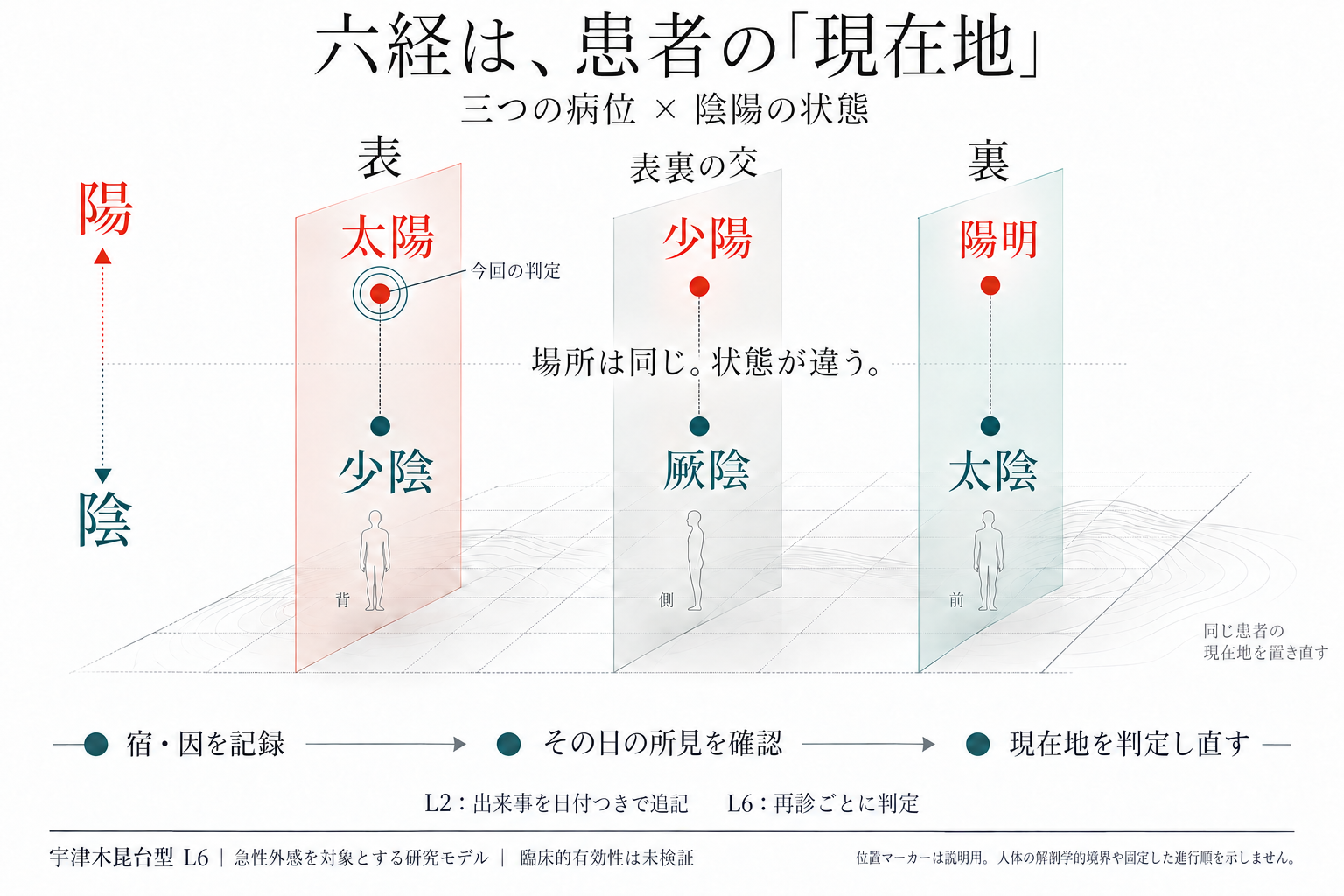
View full-size diagram (Japanese)
Horizontally are three locations: exterior, their junction, and interior. The upper row is taiyang, shaoyang, yangming; the lower is shaoyin, jueyin, taiyin, pairing yang and yin states at each location. Up/down does not mean upper/lower body or mild/severe disease. The marker illustrates reassessment of the current position at every return visit.
What Each Work Argues
The 72-work index summarizes each reading and judgment structure. Each row includes title, author/responsibility, key points, placement of the three yin, and a holding link where public images were confirmed.
Download the Work-by-Work Index (Excel)
Nangai-related works are distinguished: Ihan (diagnostic principles), Kiketsusui Yakucho (medicinal classification), Shanghan Lun Shoku (textual arrangement), and Shanghan Lun Seigi Gaiden (recorded late oral teaching).
Meaning for Acupuncturists
Memorizing Shanghan Zabing Lun merely as external-illness classifications misses coexistence with miscellaneous disease, post-treatment change, and intervention priorities. Kontai places the conformations on posterior, lateral, and anterior body regions and identifies the principal location as hon. For acupuncturists, it offers a bodily framework for reconsidering onset order, coexisting findings, treatment history, and subsequent changes. Classical formulas are not mechanically converted into acupuncture points.
Remaining Questions
This choice leaves matters to verify.
- Test passages were scored by one evaluator and selected to examine Kontai's points. Coherence must be checked through independent scoring and expansion to all passages.
- Liu Dong's Shanghan Lun Ryushi Den provides a precedent for corresponding locations. Our scope is limited; we do not call Kontai the first.
- Kontai's shuku broadly includes ordinary illnesses, land, diet, and disposition and does not map one-to-one onto MLMN record categories.
- Volume and leaf references in quotations will continue to be checked against original images.
- Whether identical findings yield identical judgments and whether predicted courses are accurate will be clinically tested through appropriate ethics and anonymization procedures.
This is a report of literature-research progress, not a journal-peer-reviewed paper or a demonstration of clinical effectiveness.
Supplementary Notes
Modern TCM describes patterns as summarizing etiology, nature, location, and dynamics at a stage of disease and also seeks dynamic changes in research. The L2/L6 distinction does not claim these concepts are absent; it is MLMN's design for separating recording and judgment.
Original images were used to check progression, decline, and residual heat in Suwen Relun (Kyoto c0162), and reassessment according to post-treatment pulse and presentations in the reprinted Song Shanghan Lun (pp. 66 and 112).